Politics and public life
Theodore Roosevelt
Reform, citizenship, and the 1912 campaign
Theodore Roosevelt’s 1912 campaign recordings preserve a public speaker making his case to voters. They offer a starting point for exploring progressive politics, citizenship, and how politicians addressed an audience through the early phonograph.
The life of Theodore Roosevelt
From New York to the Dakota Badlands
Theodore Roosevelt was born in New York City on October 27, 1858. He graduated from Harvard in 1880 and entered New York state politics while still a young man. His interest in animals and the outdoors accompanied a growing career as a writer. Visits to the Dakota Territory brought experience of ranching, hunting, and the vulnerability of land and livestock. In February 1884 his mother and first wife died on the same day. Those documented events belong in his biography; they do not establish the private conversations or feelings a reconstruction might be tempted to invent. [R1]
Public office and the Square Deal
Roosevelt held civil-service, police, and naval posts before serving in Cuba with the Rough Riders in 1898. He became governor of New York, then vice president. After William McKinley’s death in September 1901, Roosevelt assumed the presidency at 42, the youngest person to enter that office. His domestic programme used federal power to address corporate abuses and consumer protection. By 1910, his New Nationalism argument called for public welfare to take precedence over entrenched private privilege. It was a political position to examine, rather than proof that every policy benefited everyone equally. [R10] [R4]
Public lands and power abroad
Conservation was a lasting part of Roosevelt’s presidency. His administration expanded national forests, wildlife reserves, parks, and monuments, while treating some resources as assets to be managed for continued use. That record is broader than simply creating the National Park Service: the service itself was established after his presidency. Internationally, he combined diplomacy with an assertive conception of American power. His mediation of the Russo-Japanese War brought the 1906 Nobel Peace Prize. The 1904 Roosevelt Corollary also supplied a justification for intervention in Latin America and the Caribbean. A full account considers the people affected by that exercise of power. [R2] [R5] [R6]
Race, exclusion, and the limits of reform
Roosevelt’s record on race resists an uncomplicated story of progress. His correspondence with Booker T. Washington documents the controversy around their 1901 White House dinner. In 1906 he ordered the discharge without honor of 167 Black soldiers after disputed accusations arising from the Brownsville incident. The soldiers’ collective punishment and the later reversal are essential context. These events should not be erased by a sympathetic presentation of conservation or reform, nor replaced with invented confessions about Roosevelt’s private motives. [R12] [R7] [R8]
The campaign of 1912 and the later years
After leaving office in 1909, Roosevelt remained a highly visible public figure. In 1912 he challenged Taft, then ran as the Progressive Party’s presidential candidate. An assassination attempt in October and his November election defeat occurred after the September setting chosen for this reconstruction. His subsequent South American expedition, arguments over the First World War, and death at Sagamore Hill on January 6, 1919 belong to the full biography. They cannot become memories of a character anchored in September 1912. [R1] [R11]
A life in dates
This timeline covers the full life. A future historical conversation will use the perspective of September 1912; later events will remain separate from that reconstruction’s memories.
- 1858-10-27 Born in New York City. [R1]
- 1880 Graduates from Harvard. [R1]
- 1883 Begins his connection with the Dakota Badlands. [R1]
- 1884-02-14 His mother and first wife die on the same day. [R1]
- 1898 Serves in Cuba and is elected governor of New York. [R10]
- 1901-09-14 Becomes the 26th president after McKinley’s death. [R1]
- 1904 Wins election to a full presidential term. [R10]
- 1904-12 Sets out the Roosevelt Corollary. [R6]
- 1906 Orders the Brownsville discharges. [R7]
- 1906 Awarded the Nobel Peace Prize. [R5]
- 1909-03 Leaves the presidency. [R1]
- 1910-04-23 Delivers Citizenship in a Republic at the Sorbonne. [R3]
- 1910-08-31 Delivers the New Nationalism speech. [R4]
- 1912-08 Becomes the Progressive presidential nominee. [R1]
- 1912-09 A campaign recording is released on Edison Blue Amberol 3707. [R9]
- 1912-10-14 Is shot before a campaign speech. [R1]
- 1912-11-05 Loses the presidential election to Woodrow Wilson. [R1]
- 1919-01-06 Dies at Sagamore Hill. [R11]
- 1972 The Brownsville soldiers receive honorable discharges in a later reversal. [R8]
Documented words
These are short excerpts from identified texts, rather than newly generated dialogue.
It is not the critic who counts;
A short excerpt from an argument about citizenship, effort, and responsibility, not a general instruction to disregard criticism.
The object of government is the welfare of the people.
Part of his stated case for stronger public control over powerful private interests.
Questions and limits in the evidence
Claim to check: An NPS timeline labels the award as 1905 within a 1910 entry.
Use the Nobel institution’s 1906 award record; preserve the disagreement instead of silently merging dates. [R1] [R5]
Claim to check: A public reform programme proves equal treatment or private benevolence.
Separate advocated ideals from Brownsville, racial exclusion, and actual policy outcomes; do not invent motives. [R4] [R7] [R12]
Claim to check: Theodore Roosevelt created the National Park Service.
Distinguish his protected-land actions from the service’s establishment in 1916; the latter is outside the chosen period. [R2]
Claim to check: A surviving recording supplies a complete personal voice or private memory.
Catalog identity and release chronology do not establish everyday manner, intimacy, or synthesis permission. [R9]
A source-checked editorial draft, assembled from the references below. It has not yet had an independent historian’s review.
Biography sources
- [R1] Theodore Roosevelt timeline — National Park Service
Childhood; public office; presidency; after the presidency
- [R2] Theodore Roosevelt and conservation — National Park Service
Public Lands Established by Theodore Roosevelt
- [R3] Citizenship in a Republic — Theodore Roosevelt Association
Sorbonne speech, April 23, 1910; paragraph beginning It is not the critic
- [R4] Remarks in Osawatomie: The New Nationalism — American Presidency Project
Speech dated August 31, 1910; discussion of public welfare and special interests
- [R5] Theodore Roosevelt: Nobel Peace Prize facts — Nobel Prize
1906 prize; mediation of Russo-Japanese War
- [R6] Roosevelt Corollary to the Monroe Doctrine — Office of the Historian
December 1904 corollary and intervention
- [R7] Brownsville Incident — Theodore Roosevelt Center
Discharge without honor of 167 Black soldiers and contested accusations
- [R8] John Bartlett to Lanham, August 17, 1906 — Texas State Library
Letter and institutional explanation of the discharges and 1972 reversal
- [R9] Documentary recordings and political speeches — National Park Service
The right of the people to rule; EDIS 39850; September 1912 release
- [R10] Theodore Roosevelt biography — National Park Service
Political career and presidency
- [R11] Theodore Roosevelt Papers timeline — Library of Congress
1858–1919 chronology
- [R12] Letter from Theodore Roosevelt to Booker T. Washington, November 2, 1901
Catalog summary and dated correspondence after the White House dinner
Hear the historical recording
The right of the people to rule · First released September 1912 · About 5 minutes
This is an archival recording of Theodore Roosevelt, as identified by the archive. It is separate from any future AI-generated dialogue.
Listen at the National Park Service
National Park Service, Thomas Edison National Historical Park
Reading the historical record
A responsible historical conversation needs to distinguish campaign rhetoric from the broader record of his presidency and political career. Questions about reform should also examine who benefited, who was excluded, and how his positions changed over time.
Questions worth exploring
- What did Roosevelt mean by the right of the people to rule?
- How did the phonograph change political campaigning?
- Whose perspectives are missing from a campaign speech?
Recordings, images, and archival sources
These links lead to the archives. Inclusion is a research reference, not a claim that every item is cleared for reuse.
-
recording · Original release documented
The right of the people to rule (1912)
The National Park Service lists a September 1912 release, Edison Blue Amberol 3707, EDIS 39850.
-
reference · Reference
Archive context and supporting evidence
Context for research; this reference does not approve a reconstruction.
-
photograph · Original publication documented
Photographic source lead
Underwood & Underwood, c1912 May 27; copyright registration J169590; LC-DIG-stereo-1s01934. The Library of Congress lists no known publication restrictions. Exact reuse remains under review.
-
reference · Historical context
Theodore Roosevelt biography — National Park Service
Biographical context for the editorial profile; individual archive items require separate review.
-
photograph · Pre-1926 publication documented
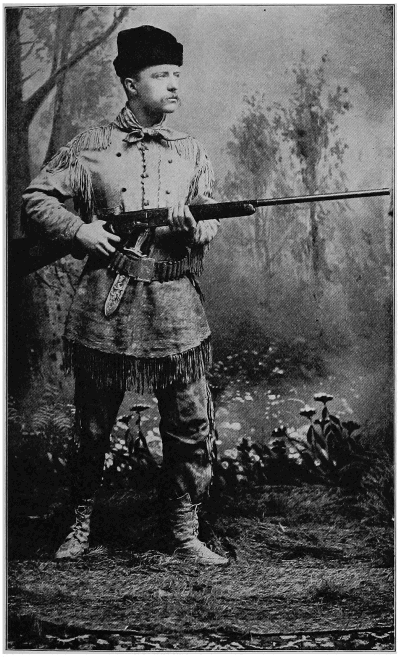
Mr. Roosevelt as a Hunter in his Ranching Days — selected published portrait
Not identified in the selected book caption. Included in Theodore Roosevelt, Edmund Lester Pearson, Macmillan, plate facing page 48; published July 1920. This reference does not approve a synthetic likeness.
-
reference · Publication evidence
Printed edition documenting the selected portrait
The publication statement and photographic caption were inspected. Digital upload dates are separate from the original print publication.
Source notes reviewed . Publication evidence and permission for a reconstruction are separate questions.