Politics and public life
William Howard Taft
Labor, campaigning, and the early recorded speech
William Howard Taft’s 1908 campaign recordings provide a route into the political arguments of the period. The rights of labor records him speaking during the presidential campaign and allows listeners to examine the words, priorities, and delivery of an early recorded political appeal.
The life of William Howard Taft
A legal career before national office
William Howard Taft was born in Cincinnati, Ohio, on September 15, 1857. He graduated from Yale in 1878 and completed his legal education in Cincinnati in 1880. His working life included legal practice, prosecution, and service on Cincinnati’s Superior Court. National appointments followed: solicitor general, then a federal judgeship in the Sixth Circuit. He also taught law and served as a dean. This background helps explain why courts, legal authority, and the design of institutions recur in his public arguments; it does not establish an unchanging private philosophy. [T1] [T2]
American colonial government in the Philippines
In 1900 Taft left the federal bench to lead the second Philippine Commission. He became civil governor on July 4, 1901, while the United States imposed colonial rule against Filipino resistance. His administration developed civil institutions, education, and infrastructure, and sought cooperation with influential Filipinos. These policies also preserved American control. His arguments about preparing Filipinos for self-government reflected paternalistic and racial assumptions. Civil administration operated alongside a destructive war, including documented torture and civilian suffering. Institutional reforms and coercive colonial power both belong in the account, with Filipino perspectives given their own place. [T3] [T4]
Labor, regulation, and the 1908 campaign
Taft became secretary of war in 1904 and was the Republican presidential nominee by the summer of 1908. His acceptance address supported continuing action against unlawful corporate conduct while giving legitimate businesses clearer rules. On labor, he recognized workers’ ability to organize and strike, but defended injunctions against actions he regarded as unlawful injury to business. He argued that notice and a hearing should usually precede temporary restraints. Those positions resist a simple description of Taft as either an opponent of every union activity or an advocate of unrestricted labor action. They are documented campaign arguments, not evidence that every promised benefit occurred. [T2] [T5]
The presidency, courts, and a later reputation
Taft won the 1908 election and served as president from 1909 to 1913. His inaugural address pledged to continue important reforms associated with Roosevelt. After his 1912 defeat, he taught at Yale. Harding appointed him chief justice in 1921; he took the judicial oath on July 11 and resigned in February 1930. His judicial record included opposition to some labor regulation alongside a dissent defending a minimum-wage law. Broad political labels can conceal such differences between individual decisions. He died on March 8, 1930. This full-life profile includes events the September 1908 reconstruction cannot yet remember, including winning the presidency itself. [T1] [T2] [T8]
A life in dates
This timeline covers the full life. A future historical conversation will use the perspective of September 1908; later events will remain separate from that reconstruction’s memories.
- 1857-09-15 Born in Cincinnati, Ohio. [T1]
- 1878 Graduates from Yale. [T1]
- 1880 Completes legal education in Cincinnati. [T1]
- 1887 Begins Cincinnati Superior Court service. [T1]
- 1890 Becomes US solicitor general. [T1]
- 1892-03-17 Confirmed and commissioned as a Sixth Circuit judge. [T1]
- 1900-03-15 Resigns his federal judgeship before Philippine Commission service. [T1]
- 1901-07-04 Becomes civil governor of the Philippines. [T3]
- 1904 Becomes secretary of war. [T2]
- 1908-07-28 Delivers his Republican nomination acceptance address. [T5]
- 1908-08-03 Records The rights of labor. [T7]
- 1908-09 The rights of labor is released as Edison Gold Moulded 9999. [T7]
- 1909-03-04 Begins his presidency and delivers his inaugural address. [T8]
- 1912 Loses reelection. [T2]
- 1913 Begins post-presidential teaching at Yale. [T2]
- 1921-07-11 Takes the chief justice’s oath. [T1]
- 1930-02-03 Resigns as chief justice. [T1]
- 1930-03-08 Dies. [T1]
Documented words
These are short excerpts from identified texts, rather than newly generated dialogue.
workmen have a right to strike in a body.
A clause from a longer discussion that qualifies permissible strike conduct; not an endorsement of unrestricted labor action.
must feel a heavy weight of responsibility.
A short clause referring to taking the presidential oath. It is later than the September 1908 conversation setting.
Questions and limits in the evidence
Claim to check: A later judicial decision reveals what Taft had already done in 1908.
Separate later case history from period knowledge; do not use retrospective labels to invent memories or motives. [T1] [T2]
Claim to check: Civil institutions prove that colonial government was freely accepted.
Include Filipino resistance and coercive conditions, distinguishing Taft’s justifications from an independent historical account. [T3] [T4] [T6]
Claim to check: The 1902 collected volume is entirely Taft’s writing.
Preserve separate authorship; the opening Roosevelt essay must never become a Taft quotation. [T6]
Claim to check: An archived recording establishes synthesis permission or a private conversational personality.
Catalog evidence establishes identity and chronology only; no audition or cloning approval is implied. [T7]
A source-checked editorial draft, assembled from the references below. It has not yet had an independent historian’s review.
Biography sources
- [T1] William Howard Taft — Federal Judicial Center
Federal Judicial Service; Education; Professional Career
- [T2] William Howard Taft — Department of Justice
Early career; after his defeat; judicial record
- [T3] The Philippines, 1898–1946 — US House Historian
Second Philippine Commission and civil governor; notes 74–90
- [T4] The Philippine-American War — Office of the Historian
War, resistance, and civilian suffering
- [T5] Address Accepting the Republican Presidential Nomination — American Presidency Project
July 28, 1908; labor discussion beginning In order to induce their employer
- [T6] Civil Government in the Philippines — Taft, in The Philippines: The First Civil Governor, 1902
Image 33 identifies Taft’s essay; image 35 begins his text
- [T7] Documentary recordings and political speeches — National Park Service
The rights of labor; EDIS 39851; September 1908 release
- [T8] Inaugural Address of William Howard Taft — Yale Avalon Project
March 4, 1909; opening paragraph; editorial-only after the cutoff
Hear the historical recording
The rights of labor · First released September 1908 · About 3 minutes
This is an archival recording of William Howard Taft, as identified by the archive. It is separate from any future AI-generated dialogue.
Listen at the National Park Service
National Park Service, Thomas Edison National Historical Park
Reading the historical record
The recording is evidence of a particular public argument. Understanding it also means asking how workers and political opponents described the same issues. A historical conversation should explain that context and distinguish statements made during a campaign from subsequent policy and judicial decisions.
Questions worth exploring
- How did Taft present the rights of labor in 1908?
- Who was the intended audience for a campaign record?
- How can we compare political promises with later decisions?
Recordings, images, and archival sources
These links lead to the archives. Inclusion is a research reference, not a claim that every item is cleared for reuse.
-
recording · Original release documented
The rights of labor (1908)
The National Park Service lists a September 1908 release, Edison Gold Moulded 9999, EDIS 39851. This is a different recording from The farmer and the Republican Party.
-
reference · Reference
Archive context and supporting evidence
Context for research; this reference does not approve a reconstruction.
-
photograph · Photograph review pending
Photographic source lead
Harris & Ewing, 1908; LC-DIG-ppmsca-38923. The Library of Congress lists no known publication restrictions; its publication information is inferred from a similar photograph. Exact reuse remains under review.
-
reference · Historical context
William Howard Taft’s public service — National Park Service
Historical background on Taft’s presidency and judicial service.
-
photograph · Pre-1926 publication documented
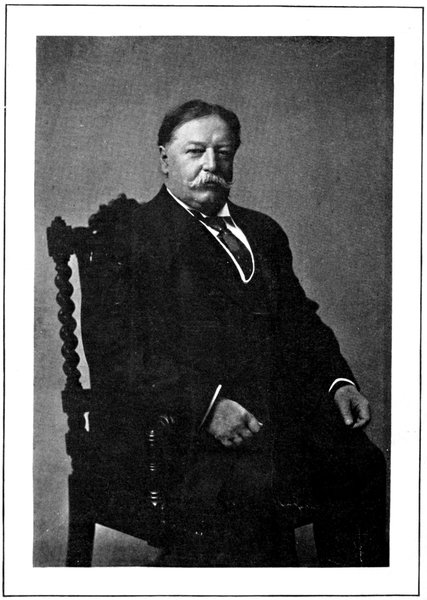
President Taft — selected published portrait
Pach Bros., New York. Included in Washington: Its Sights and Insights, Harriet Earhart Monroe, revised edition, Funk & Wagnalls, frontispiece; published September 1909. This reference does not approve a synthetic likeness.
-
reference · Publication evidence
Printed edition documenting the selected portrait
The publication statement and photographic caption were inspected. Digital upload dates are separate from the original print publication.
Source notes reviewed . Publication evidence and permission for a reconstruction are separate questions.